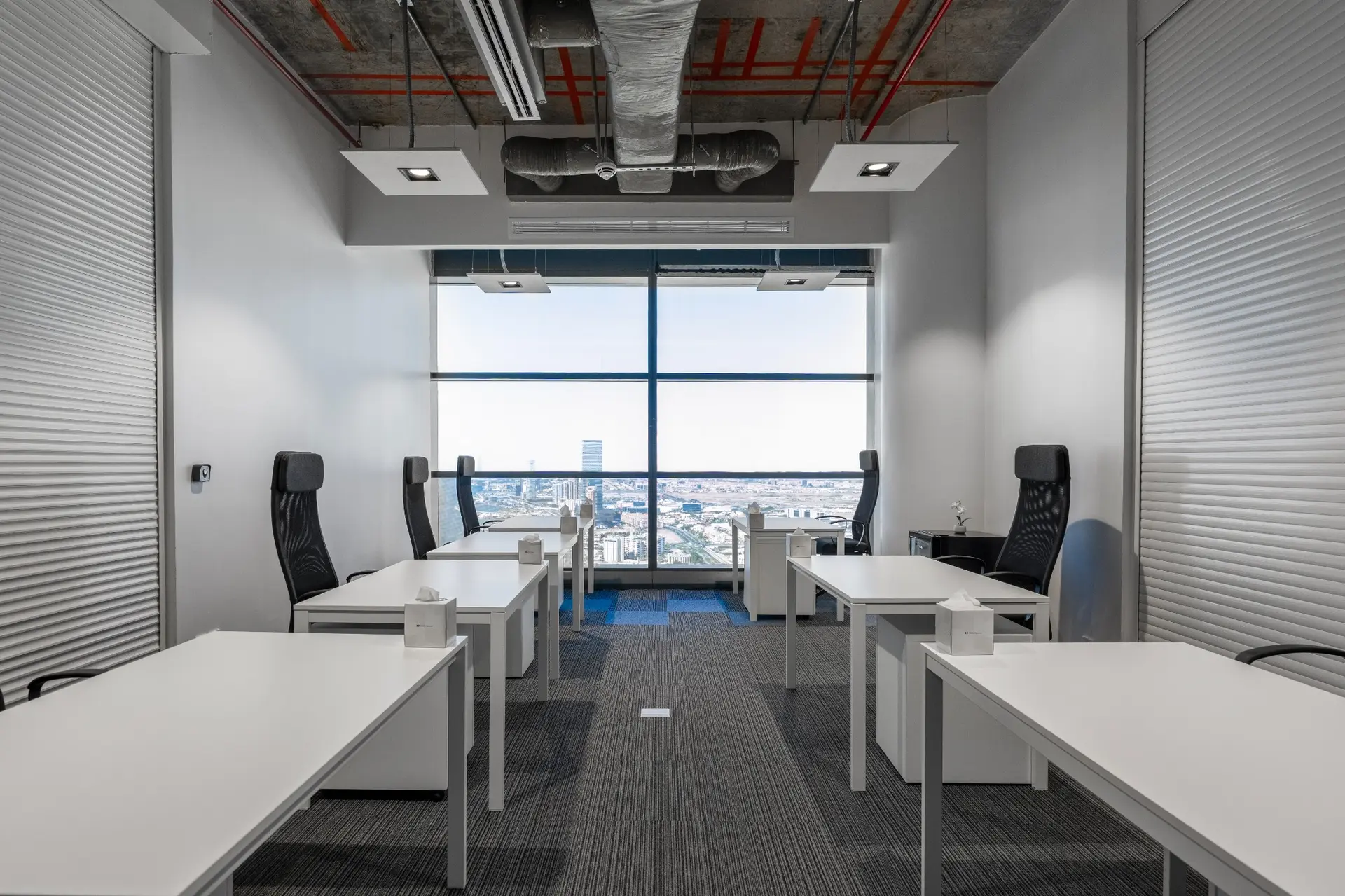
In briefA serviced office is usually a ready private room within a shared business centre, with common reception, meeting and hospitality facilities. A managed office is usually a more self-contained workplace prepared for one company, with greater control over layout, identity, access and operating standards. The labels are not regulated product definitions, so compare the written scope, not the name.
Two ready-to-work models, different levels of control
- Serviced office: Fast, standardized and supported by shared facilities
- Managed office: More private, tailored and operationally defined
- Best comparison: One brief, one term and one complete cost model
The short answer: the boundary is control, not furniture
Both models can be furnished, connected and ready for work. The useful distinction is how much of the workplace is dedicated to one company and how much the operator can tailor. A serviced office typically gives a team an enclosed office while reception, lounges, meeting rooms and hospitality remain shared. A managed office typically gives one company a self-contained suite or floor with a defined service layer and more influence over planning, branding, access and technology.
Industry language overlaps. One provider may call a large serviced suite a managed office; another may reserve ‘managed’ for a bespoke single-occupier floor. JLL describes managed offices as private, self-contained space designed and run for a single occupier, often with fit-out, utilities and technology covered by one fee. Treat that as a useful market definition, then make the contract specify the actual product.
- Decision factor: Occupancy; Serviced office: Private office in a shared centre; Managed office: Usually a self-contained suite or floor
- Decision factor: Speed; Serviced office: Fast when a suitable room is available; Managed office: Depends on design, approvals and customization
- Decision factor: Identity; Serviced office: Limited changes inside a standard setting; Managed office: More scope for signage, layout and brand cues
- Decision factor: Shared facilities; Serviced office: A core part of the model; Managed office: Can be shared, dedicated or a defined mix
- Decision factor: Commercial structure; Serviced office: Often shorter and more standardized; Managed office: Often longer because delivery is tailored
- Decision factor: Best fit; Serviced office: Small teams, launch teams and uncertain headcount; Managed office: Established, enterprise or project teams needing control
Why this distinction matters in Saudi Arabia in 2026
The latest evidence makes speed and specification commercially important. CBRE’s Saudi Arabia review published on 3 August 2026 said Riyadh prime Grade A occupancy remained near capacity in Q2, while average prime rents reached SAR 3,320 per square metre, up 3% year on year. That does not make one office model automatically cheaper. It means delays, unsuitable space and unused capacity can carry a meaningful opportunity cost.
JLL’s Q2 2026 view is more city-specific: Riyadh retained strong fundamentals, Jeddah was gradually recovering, and the Dammam Metropolitan Area remained more cautious. It also reported companies in Riyadh and Jeddah expanding and upgrading their offices. The practical response is to compare availability, building quality, commute and expansion path in the city where the team will actually work, not apply a single national rule.
For White Spaces, that city decision can be tested against real locations: Al Mursalat and Al Moaiqliah in Riyadh; HQ Tower, Randa Tower and Al Khayyat in Jeddah; and Al Bargash Tower on the Al Khobar Corniche. Services and available configurations vary, so shortlist the branch before assuming a format is offered.
Choose from the operating brief, not the team size alone
A five-person advisory team handling confidential client work may need more control than a 20-person project team using the office intermittently. Start with work patterns: expected daily attendance, confidential calls, visitor frequency, meeting peaks, storage, access hours, network requirements and who owns day-to-day workplace issues.
Choose a serviced office when the priority is starting quickly, keeping commitment light and using shared facilities efficiently. Choose a managed office when the company needs a distinct team environment, controlled visitor and staff journeys, more predictable dedicated capacity, brand expression or a service standard written around its operation. If those needs are uncertain, begin with a ready private office and define the trigger for moving to a large-team or custom office solution.
Three common decision patterns
- Market-entry team: prioritize speed, a credible place to meet and a written expansion path; a serviced private office is often the cleaner first step.
- Established department: prioritize dedicated capacity, identity, access rules and predictable service; a managed suite may fit better.
- Fixed-term project: match the office term and capacity to project milestones, including a clear extension and exit option; either model can work.
Build one all-in cost comparison
Do not compare two monthly fees until both quotes cover the same headcount, term, working hours and service level. Put every line into a 12-, 24- or 36-month model: deposit, VAT, setup or customization, furniture, internet and network support, utilities, cleaning, reception, security, meeting-room use, printing, parking, refreshments, storage, access cards, repairs, insurance requirements, changes during the term and exit costs.
Then add two operational values: time to productive occupancy and internal management hours. A lower visible fee can lose its advantage if launch is delayed or an internal employee must coordinate multiple vendors every week. Use the same method as the total office occupancy cost guide, and test the capacity with the space-per-employee guide.
- Scenario to test: Headcount rises; Question for the quote: Can we add seats or an adjacent room, at what notice and price?
- Scenario to test: Headcount falls; Question for the quote: Can capacity reduce before renewal, and is there a fee?
- Scenario to test: Meeting peak; Question for the quote: How many room hours are included, and what are overage rates?
- Scenario to test: IT or access change; Question for the quote: Who approves and delivers the change, on what service level?
- Scenario to test: Early exit; Question for the quote: What notice, charges, reinstatement and data-return duties apply?
Use a procurement checklist that exposes the real service
Issue one written brief to every shortlisted operator. Ask each provider to mark every requirement as included, optional, unavailable or client-managed. Request the final schedule of inclusions with the contract; a sales presentation is not an operating commitment.
Ten questions to ask before signing
- Which rooms and facilities are dedicated to us, and which are shared?
- What furniture, signage, layout and branding changes are allowed?
- What internet service, network separation and support response are included?
- How are staff, visitors, deliveries and after-hours access controlled?
- Which cleaning, maintenance, reception, security and hospitality tasks are included?
- How are meeting rooms allocated, booked and charged?
- What is the realistic handover date, and what must happen before it?
- What can expand, contract or change during the term?
- Who owns installed equipment, furniture, access data and configuration at exit?
- What is excluded from the quoted fee, including VAT and usage overages?
Turn the comparison into a White Spaces shortlist
White Spaces offers furnished private offices with daily workplace support and flexible monthly or annual terms, plus larger-team and custom private-office pathways where available. To make a useful comparison, send the team size, target city, preferred move-in date, meeting pattern, privacy or IT requirements and expected term. The team can then confirm which real branches and configurations should be toured.
Start by comparing private office solutions and locations across Riyadh, Jeddah and Al Khobar, then book a tour. Ask for the inclusion schedule in writing and compare it with a traditional lease using our separate serviced-office guide.
FAQ
What is a managed office?
A managed office is usually a private, self-contained workplace prepared and operated for one company. The provider may bundle fit-out, furniture, utilities, technology and daily services, but the exact scope must be confirmed in writing.
Is a managed office the same as a serviced office?
Not always. A serviced office is commonly a ready private room within a shared centre. A managed office is commonly more self-contained and tailored to one occupier. Providers use the labels differently, so compare dedicated space, services and contract terms.
Which is cheaper: a managed or serviced office?
There is no universal winner. A serviced office can cost less for a small team using shared facilities. A managed office can create better value for a larger or established team that would otherwise pay separately for fit-out, dedicated facilities and internal operations. Compare the same term and complete scope.
Can a managed office carry our company branding?
Often yes, but permissions vary. Confirm exterior and interior signage, reception identity, room names, finishes, digital displays and reinstatement duties before design work starts.
Are meeting rooms and parking included?
Do not assume they are. Ask whether rooms or parking bays are dedicated, shared, credit-based or charged by use, and record any limits and overage rates in the contract schedule.
Which model is better in Riyadh, Jeddah or Al Khobar?
The answer depends on live availability, building quality, commute, team size and operating needs. Riyadh currently has tighter prime supply, while Jeddah and the Eastern Province have different market conditions. Compare real branches and written scopes in the target city.